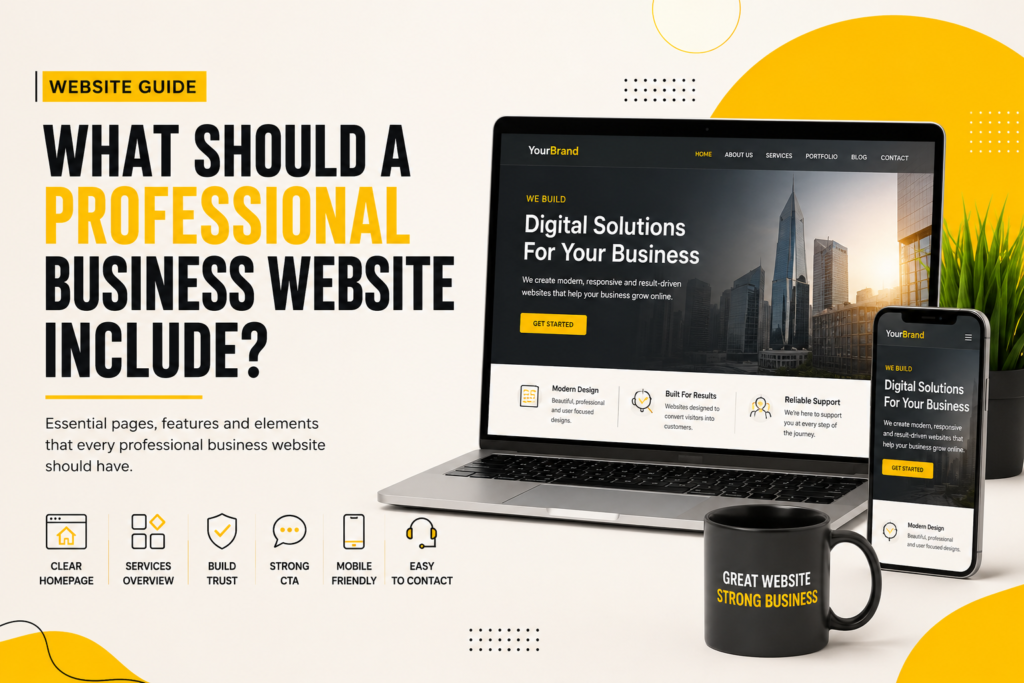
What Should a Professional Business Website Include?
Book a Call Book a Call BUSINESS WEBSITE GUIDE What Should a Professional Business Website Include? Discover the essential pages, sections, trust elements, calls to action and design features that can make your business website professional, clear and easy to use. Product Page World • Website Design • 8 min read Website Essentials Build around your business and your customers. A professional website should make your business clear, credible and easy to contact. A professional business website is more than just a homepage with your company name, services and contact details. Your website should clearly explain who you are, what your business offers, why customers should trust you and what they should do next. For many potential customers, your website is their first interaction with your business. A well-planned business website design can make your company look credible, communicate your services clearly and make it easier for visitors to contact you. But what exactly should a professional business website include? Let’s look at the essential elements every business should consider when planning a new website. Your website should answer three questions quickly. Who are you? What do you offer? And what should the visitor do next? 1. A Clear and Professional Homepage The homepage is usually the first page visitors see, so it needs to communicate your business quickly. A professional homepage should explain who you are, what you offer and how someone can get started. ✓ A clear and relevant headline ✓ Short introduction to your business ✓ Main products or services ✓ Key benefits and differentiators ✓ Testimonials or trust elements ✓ A strong call-to-action A clear homepage helps visitors understand your business quickly. 2. A Clear Services or Products Section One of the most important parts of a professional business website is a clear explanation of what you offer. If your business provides multiple services, don’t simply list them in one paragraph. Create a clear section that allows visitors to understand each service. 01 Clear Service Names Help visitors immediately understand what your business provides. 02 Useful Descriptions Explain what each service does and who it is for. 03 Clear Next Step Give visitors an easy way to enquire or get started. 3. Dedicated Service Pages A common mistake businesses make is putting every service on one page. If you offer several important services, dedicated service pages can create a much better website structure. Home → Services → Service Page → Contact Each important service page can explain the service, benefits, features, process, frequently asked questions and the next step for potential customers. 4. An About Us Page People don’t only want to know what you sell. They also want to know who they’re dealing with. An effective About Us page can introduce your company, team, experience, values and approach. The goal is to build familiarity and trust without overwhelming visitors with your entire company history. 5. A Strong Contact Page A website isn’t very useful if visitors can’t easily contact your business. Your Contact Us page should make getting in touch simple. ✓ Contact form ✓ Phone number and email ✓ Business address ✓ Business hours ✓ Location map where relevant ✓ Preferred contact options Make it easy for potential customers to take the next step. 6. Clear Calls to Action Every professional business website should guide visitors toward a specific action. This is where calls to action become important. → Get a Free Consultation → Request a Quote → Book a Call → Get Started Your CTA should match the goal of the page and tell visitors exactly what they can do next. 7. Customer Testimonials and Reviews Visitors may be interested in your services, but they may still have one important question: Can I trust this business? Testimonials and customer reviews can help answer that question. A professional website can include genuine customer feedback, reviews, case studies, project results or client logos where appropriate. 8. Trust-Building Information A professional business website should provide enough information for visitors to feel confident about contacting you. ✓ Years of experience ✓ Certifications or awards ✓ Client logos where appropriate ✓ Case studies and testimonials 9. Mobile-Friendly Website Design A professional website should work properly across smartphones, tablets, laptops and desktop computers. Your business website design should be responsive so visitors can navigate the website, read content, use buttons and complete forms comfortably on different screen sizes. 10. Simple and Easy Navigation Good website navigation helps visitors find information without confusion. Home About Services Portfolio Contact If visitors have to think too much about where to click, your navigation probably needs improvement. Keep your main menu simple and organize additional information into logical page groups. 11. A Professional Visual Design The appearance of your website influences how people perceive your business. A professional website design should have consistency across colors, fonts, buttons, images, spacing, headings and section layouts. Your website should also reflect your brand. A law firm, restaurant, construction company, fashion brand and technology company may all require completely different visual styles. 12. High-Quality Images and Visual Content Images can make a business website more engaging, but they should serve a purpose. Use relevant images for products, services, team members, projects, locations, work examples and brand identity. Avoid using random stock images simply to fill empty space. 13. A Portfolio or Work Showcase If your business provides creative, professional or project-based services, a portfolio can be one of the most valuable sections of your website. A portfolio allows potential customers to see what you have actually done. Depending on your business, you can showcase previous websites, branding projects, construction projects, interior projects, photography, design work or completed client projects. 14. Frequently Asked Questions A FAQ section can answer common questions before a visitor contacts you. Focus on real questions your customers commonly ask. 01 What do you provide? Clearly explain your main services or products. 02 How do I get started? Explain the first step a potential customer should take. 03 How can I contact you?